
Most suppliers take test specimens only from the central section of each master roll. MD/TD shrink‑balance looks acceptable on central samples, but edge‑zone material can exhibit skewed shrink ratios caused by uneven air‑gap cooling during double‑bubble extrusion. When slit down into stationery‑sized working rolls, some sub‑rolls carry off‑balance material. On high‑speed stationery packaging lines, partial batches show obvious corner puckering and uneven wrapping tension, ruining the neat retail‑ready appearance expected for notebooks, pencil sets and gift stationery kits. DHHeatshrink extracts test coupons across multiple positions covering full master‑roll width for every production lot, verifying uniform shrink‑balance across the complete web. This eliminates edge‑originated puckering risk for slitted stationery‑grade film rolls and stabilises finished‑goods visual consistency.
Minor additive‑loading drift changes surface slip properties roll‑to‑roll. Stationery packaging machines run at sustained high line speeds; even small COF deviation creates intermittent film‑web wandering, mis‑feeding and jam‑ups. Operators keep readjusting machine tension setting for every new film roll, hurting overall equipment effectiveness. Pure visual inspection cannot detect friction‑value shifts. DHHeatshrink maintains fixed slip‑additive dosing parameters for stationery‑grade formula, running ASTM D1894 COF testing per lot. Consistent surface‑slip characteristics remove constant machine‑readjustment burden for converters running mixed‑SKU stationery‑packaging production cycles.
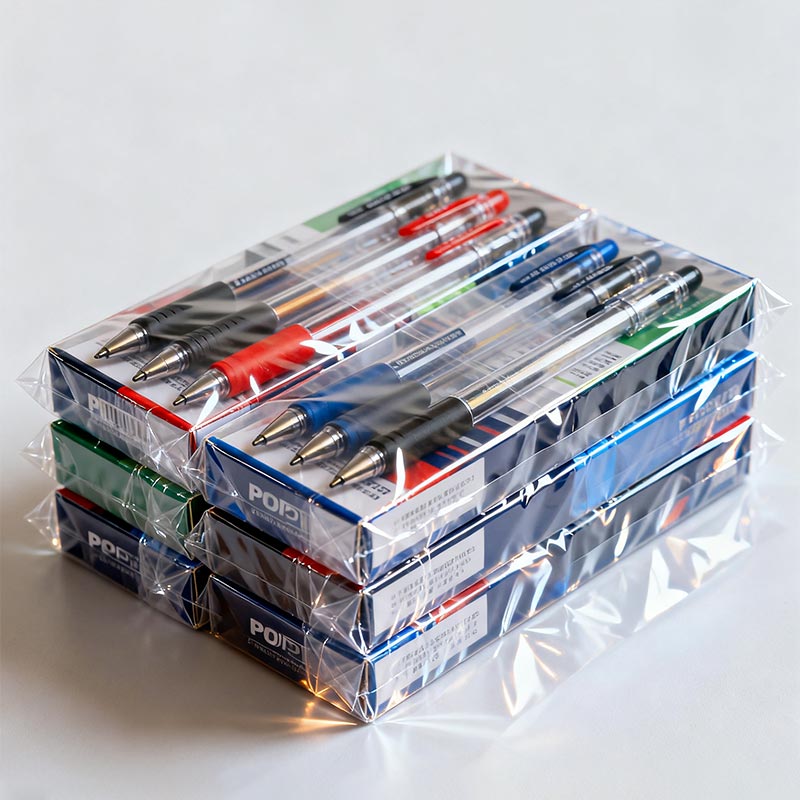
Haze drift comes from inconsistent polymer melting temperature or scattered micro‑gel particles generated during extrusion. Individual sample pieces can look perfectly transparent, but sequential production rolls display slight but perceptible differences in clarity. Once applied across large stationery product batches, varying transparency creates mismatched shelf appearance for identical SKUs. Retail buyers reject mixed‑look stock for chain‑store distribution. DHHeatshrink monitors gel‑count and haze value inline during extrusion. Finished‑roll acceptance thresholds are locked for stationery applications, ensuring optical uniformity from roll‑to‑roll and avoiding heterogeneous shelf‑presentation risks for stationery retail assortments.
Stationery packaging factories frequently run fluctuating line‑speeds when switching between small pencil packs and larger notebook sets. If POF film possesses a narrow heat‑seal operating window, minor tunnel‑temperature fluctuations produce two failure modes: brittle cracked seals from over‑heating or incomplete partial seals allowing packaged stationery components to shift inside wrappers. Many suppliers only test sealing performance under fixed ideal lab‑conditions. DHHeatshrink validates seal‑strength performance across a temperature range simulating real‑world factory‑line fluctuation according to ASTM F88 standards, confirming wide usable seal‑window for variable‑speed stationery‑packaging environments.
Uncontrolled partial recycled‑polymer blending introduces unknown additive residues. While physical shrink performance may remain acceptable, such batches can exceed REACH‑SVHC substance‑thresholds. Generic one‑time sample certificates cannot represent serial‑production lots. Shipments risk customs hold‑up when entering European stationery retail supply‑chains. DHHeatshrink restricts stationery‑POF production to designated virgin resin feedstock. Each lot retains incoming‑polymer traceability records and provides English‑language material‑declaration documentation to support importer customs‑clearance and retail‑chain audit workflows.
Film that performs well on universal lab test‑equipment can still show poor adaption to specific customer‑owned L‑bar sealing and shrink‑tunnel configurations. Such incompatibility only appears after converter consumes considerable quantities of material during real‑production runs. DHHeatshrink offers application‑simulation service using customer‑provided line‑parameter profiles before mass‑order release. Potential feeding, sealing or shrink‑tunnel related issues get identified at sample‑evaluation phase instead of full‑scale manufacturing, lowering costly trial‑run‑scrap for stationery‑packaging converters.